
Friday, 3 February 2017
St. Blaise
Saint Blaise (or Saint Blase) was a physician, and bishop of Sebastea in historical Armenia (modern Sivas, Turkey). According to the Acta Sanctorum, he was martyred by being beaten, attacked with iron combs, and beheaded. He is the patron saint of wool combers. In the Latin Church his feast falls on 3 February, in the Eastern Churches on 11 February.[2]he first reference we have to him is in manuscripts of the medical writings of Aëtius Amidenus, a court physician of the very end of the 5th or the beginning of the 6th century; there his aid is invoked in treating objects stuck in the throat.
Marco Polo reported the place where "Meeser Saint Blaise obtained the glorious crown of martyrdom", Sebastea;[3] the shrine near the citadel mount was mentioned by William of Rubruck in 1253.[4] However, it appears to no longer exist.
Life[edit]
From being a healer of bodily ailments, Saint Blaise became a physician of souls, then retired for a time to a cavern where he remained in prayer. As bishop of Sebastea, Blaise instructed his people as much by his example as by his words, and the great virtues and sanctity of the servant of God were attested by many miracles. From all parts, the people came flocking to him for the cure of bodily and spiritual ills.[5] He is said to have healed animals (who came to the saint on their own for his assistance) and to have been assisted by animals.
In 316, the governor of Cappadocia and Lesser Armenia Agricolaus began a persecution by order of the Emperor Licinius and Saint Blaise was seized. After his interrogation and a severe scourging, he was hurried off to prison,[5] and subsequently beheaded.

St. John Bosco

A follower of the spirituality and philosophy of Saint Francis de Sales, Bosco was an ardent Marian devotee of the Blessed Virgin Mary under the title Mary Help of Christians. He later dedicated his works to De Sales when he founded the Salesians of Don Bosco, based in Turin.[6] Together with Maria Domenica Mazzarello, he founded the Institute of the Daughters of Mary Help of Christians, a religious congregation of nuns dedicated to the care and education of poor girls.
In 1876 Bosco founded a movement of laity, the Association of Salesian Cooperators, with the same educational mission to the poor.[7] In 1875 he began to publish the Salesian Bulletin.[8][9] The Bulletin has remained in continuous publication, and is currently published in 50 different editions and 30 languages.[8]
Bosco established a network of organizations and centres to carry on his work. Following his beatification in 1929, he was canonized as a saint in the Roman Catholic Church by Pope Pius XI in 1934.
Source: wikipedia.org
St. Thomas Aquinas

Synopsis
Philosopher and theologian St. Thomas Aquinas was born circa 1225 in Roccasecca, Italy. Combining the theological principles of faith with the philosophical principles of reason, he ranked among the most influential thinkers of medieval Scholasticism. An authority of the Roman Catholic Church and a prolific writer, Aquinas died on March 7, 1274, at the Cistercian monastery of Fossanova, near Terracina, Latium, Papal States, Italy.Early Life
The son of Landulph, count of Aquino, St. Thomas Aquinas was born circa 1225 in Roccasecca, Italy, near Aquino, Terra di Lavoro, in the Kingdom of Sicily. Thomas had eight siblings, and was the youngest child. His mother, Theodora, was countess of Teano. Though Thomas's family members were descendants of Emperors Frederick I and Henry VI, they were considered to be of lower nobility.Before St. Thomas Aquinas was born, a holy hermit shared a prediction with his mother, foretelling that her son would enter the Order of Friars Preachers, become a great learner and achieve unequaled sanctity.
Following the tradition of the period, St. Thomas Aquinas was sent to the Abbey of Monte Cassino to train among Benedictine monks when he was just 5 years old. In Wisdom 8:19, St. Thomas Aquinas is described as "a witty child" who "had received a good soul." At Monte Cassino, the quizzical young boy repeatedly posed the question, "What is God?" to his benefactors.
St. Thomas Aquinas remained at the monastery until he was 13 years old, when the political climate forced him to return to Naples.
Education
St. Thomas Aquinas spent the next five years completing his primary education at a Benedictine house in Naples. During those years, he studied Aristotle's work, which would later become a major launching point for St. Thomas Aquinas's own exploration of philosophy. At the Benedictine house, which was closely affiliated with the University of Naples, Thomas also developed an interest in more contemporary monastic orders. He was particularly drawn to those that emphasized a life of spiritual service, in contrast with the more traditional views and sheltered lifestyle he'd observed at the Abbey of Monte Cassino.Circa 1239, St. Thomas Aquinas began attending the University of Naples. In 1243, he secretly joined an order of Dominican monks, receiving the habit in 1244. When his family found out, they felt so betrayed that he had turned his back on the principles to which they subscribed that they decided to kidnap him. Thomas's family held him captive for an entire year, imprisoned in the fortress of San Giovanni at Rocca Secca. During this time, they attempted to deprogram Thomas of his new beliefs. Thomas held fast to the ideas he had learned at university, however, and went back to the Dominican order following his release in 1245.
From 1245 to 1252, St. Thomas Aquinas continued to pursue his studies with the Dominicans in Naples, Paris and Cologne. He was ordained in Cologne, Germany, in 1250, and went on to teach theology at the University of Paris. Under the tutelage of St. Albert the Great, St. Thomas Aquinas subsequently earned his doctorate in theology. Consistent with the holy hermit's prediction, Thomas proved an exemplary scholar, though, ironically, his modesty sometimes led his classmates to misperceive him as dim-witted. After reading Thomas's thesis and thinking it brilliant, his professor, St. Albert the Great, proclaimed in Thomas's defense, "We call this young man a dumb ox, but his bellowing in doctrine will one day resound throughout the world!"
Later Life and Death
In June 1272, St. Thomas Aquinas agreed to go to Naples and start a theological studies program for the Dominican house neighboring the university. While he was still writing prolifically, his works began to suffer in quality.During the Feast of St. Nicolas in 1273, St. Thomas Aquinas had a mystical vision that made writing seem unimportant to him. At mass, he reportedly heard a voice coming from a crucifix that said, "Thou hast written well of me, Thomas; what reward wilt thou have?" to which St. Thomas Aquinas replied, "None other than thyself, Lord."
When St. Thomas Aquinas's confessor, Father Reginald of Piperno, urged him to keep writing, he replied, "I can do no more. Such secrets have been revealed to me that all I have written now appears to be of little value." St. Thomas Aquinas never wrote again.
In January 1274, St. Thomas Aquinas embarked on a trip to Lyon, France, on foot to serve on the Second Council, but never made it there. Along the way, he fell ill at the Cistercian monastery of Fossanova, Italy. The monks wanted St. Thomas Aquinas to stay at the castle, but, sensing that his death was near, Thomas preferred to remain at the monastery, saying, "If the Lord wishes to take me away, it is better that I be found in a religious house than in the dwelling of a layperson."
Often called "The Universal Teacher," St. Thomas Aquinas died at the monastery of Fossanova on March 7, 1274. He was canonized by Pope John XXII in 1323.
Source: www.biography.com
St. Angela Merici

At just 10-years-old, Angela and her older sister became orphans and went to live with their uncle in Salo. There they led a quiet and devout Catholic Christian life. After the untimely death of her sister, Angela was saddened by the fact the that she had not had the opportunity to receive her last Sacraments and was concerned for her sister's eternal salvation.
Angela was inspired by the Holy Spirit to dedicate herself to the Lord and to give her life in service to the Church to help everyone grow closer to the Lord. Still filled with grief, she prayed for God to reveal the condition of her deceased sister's soul. In a vision, she learned her sister was in Heaven with the company of saints. She became increasingly more devout and joined the Third Order of St. Francis where she also pledged to remain a consecrated virgin, forsaking marriage to one man to be married to the Lord and His Church.
When Angela was 20-years-old, her uncle died and she returned to Desenzano. She found that around her hometown there were many young girls who had no education and no hope. Her heart was moved. She also became distressed by their ignorance and upset at the parents who had not educated them.
Inspired by the Holy Spirit, Angela became convinced there was great need for a better way of teaching these young girls. So, she opened her own home to them and began to teach them herself. She devotedly taught them the Catholic Christian faith. By her example and instruction, she taught them to how to pray and participate in the sacramental life of the Church. She evangelized and catechized these young girls, opening them up to the life of grace.
Another vision from the Lord revealed to Angela that she was to found an institution with other consecrated virgins to further devote their lives toward the religious training of young girls. These women had little money and no power, but were bound together by their dedication to education and commitment to Jesus Christ and service to His Church.
Living in their own homes, the girls met for prayer and classes where Angela reminded them, "Reflect that in reality you have a greater need to serve [the poor] than they have of your service."
Angela's charming nature and natural leadership qualities made this a successful endeavor. She was so successful she accepted an invitation from the neighboring town, Brescia, to establish a similar school there.
In 1524, she eagerly took on the opportunity to travel to the Holy Land. During the journey, she was suddenly struck with blindness while on the island of Crete. This didn't stop her though; she continued the journey with as much enthusiasm as she would have if she had her vision. She made the entire pilgrimage and visited the sacred shrines. On the journey back home, her sight was miraculously restored while she was praying before a crucifix in the same place where she had become blind. The Lord showed Angela through this experience that she must never shut her eyes to the needs she saw around her ? to not shut her heart to God's call.
During the Jubilee year in 1525, Angela traveled to Rome to gain the special grace of the plenary indulgence offered to all Christian pilgrims. Pope Clement VII had heard of Angela and her great holiness. He noted her wonderful success as a religious teacher for young girls and invited her to stay in Rome. Angela was humble, disliked publicity and kindly declined the generous offer.
Though she turned him down, perhaps the pope's request gave her the inspiration or the push to make her little group more formal. Although it was never recognized formally as a religious order in her lifetime, Angela's Company of Saint Ursula, or the Ursulines, was the first group of women religious to work outside of the cloister and became the first teaching order of women in the Catholic Church.
On November 25, 1535, Angela gathered together 12 young virgins and laid down the foundation for the Order of the Ursulines at a small house near the Church of St. Afra in Bresica with Angela's Company of Saint Ursula, under the patronage of St. Ursula.
Angela's goal was to elevate family life through Christian education for women ? the future wives and mothers. The community she founded was different than many of the religious orders of women which existed in her day. She believed it was important to teach the girls in their own homes with their own families. One of her favorite sayings was, "Disorder in society is the result of disorder in the family."
Though the women in the community wore no special religious habit and took no formal vows, Angela wrote a Rule of Life for those who lived and served in the community of women. They did pledge to live a life of consecrated celibacy, poverty and obedience. They lived this Rule of Life within their own homes.
This was the first group of consecrated women to work outside of a formal cloister or convent in her day and became the first teaching order of women in the Catholic Church. The community existed as what is called a "secular institute" until years after Angela's death.
The Ursulines opened both schools and orphanages and in 1537, Angela was elected "Mother and Mistress" of the group. Her Rule was officially approved by Pope Paul III in 1544 and the Ursulines became a recognized religious community of women with a teaching ministry.
Before her death, Angela reassured her Sisters who were afraid to lose her in death: "I shall continue to be more alive than I was in this life, and I shall see you better and shall love more the good deeds which I shall see you doing continually, and I shall be able to help you more."
St. Angela Merici died on January 27, 1540. Clothed in the habit of a Franciscan tertiary, Angela was buried in the Church of St. Afra in Brescia.
St. Angela Merici was beatified on April 30, 1768 by Pope Clement XIII and canonized May 24, 1807 by Pope Pius VII.
Angela is often attributed with a cloak and ladder.
She is the patron saint of sickness, disabled and physically challenged people, and those grieving the loss of parents. Her feast day is celebrated on January 27.
Source: www.catholic.org
St. Francis de Sales
Early years
Francis de Sales was born on 21 August 1567 in the Château de Sales into the noble Sales family of the Duchy of Savoy, in what is today Thorens-Glières, Haute-Savoie, France. His father was François de Sales, Lord of Boisy, Sales, and Novel. His mother was Françoise de Sionnaz, the only child of prominent magistrate, Melchior de Sionnaz, and a noblewoman. He was baptized Francis Bonaventura, after two great Franciscan saints. His father wanted him, the first of his six sons, to attend the best schools in preparation for a career as a magistrate. He therefore enjoyed a privileged education in the nearby town of La Roche-sur-Foron and at the age of eight, at the Capuchin college in Annecy.[1]Education and conversion
In 1583, De Sales went to the Collège de Clermont (later renamed Lycée Louis-le-Grand) in Paris, then a Jesuit institution, to study rhetoric and humanities. As a nobleman, he was accompanied by his own servant and by a priest tutor, Abbe Deage. To please his father, he took lessons in the gentlemanly pursuits of riding, dancing, and fencing.[2] De Sales is described as intelligent and handsome, tall and well built with blue-grey eyes, somewhat reserved and quiet, and a welcome guest in the homes of the nobility among whom his father had connections.[3]In 1584 Francis de Sales attended a theological discussion about predestination, convincing him of his damnation to hell. A personal crisis of despair resulted. This conviction lasted through December 1586. His great despair made him physically ill and even bedridden for a time. Sometime in either late December or early January 1587, with great difficulty, he visited the old parish of Saint-Étienne-des-Grès, Paris, where he prayed the "Memorare" before a famed statue of Our Lady of Good Deliverance, a Black Madonna. He consecrated himself to the Blessed Virgin Mary, and decided to dedicate his life to God with a vow of chastity. He then became a tertiary of the Minim Order.[4]
Sales ultimately concluded that God had good in store for him, because "God is love", as John's First Epistle attests. This faithful devotion to the God of love not only expelled his doubts but also influenced the rest of his life and his teachings. His way of teaching Catholic spirituality is often referred to as the Way of Divine Love, or the Devout Life, taken from a book he wrote of a similar name: Introduction to the Devout Life.
In 1588 Sales completed his studies at Collège de Clermont and enrolled at University of Padua in Italy, where he studied both law and theology. He took Antonio Possevino, a priest in Society of Jesus, as his spiritual director.[1] There he made up his mind about becoming a priest. In one incident, he rode a horse, and his sword fell to the ground and crossed another sword, making the sign of the Christian cross.
Return to Savoy
In 1592, Sales received his doctorate in law and theology. He made a pilgrimage to Loreto, Italy, famous for its Basilica della Santa Casa (Shrine of the Holy House) and then returned home to Savoy. The Senate of Chambéry admitted him as a lawyer. Meanwhile, his father secured various positions for Francis, including an appointment as senator. His father also chose a wealthy noble heiress as his bride. But Francis refused to marry, preferring to stay focused on his chosen path. His father initially refused to accept that Francis had chosen the priesthood rather than fulfill his expectations with a political-military career.[5] Claude de Granier, then Bishop of Geneva, intervened and after signing over to his younger brother his rights of family succession, he was ordained in 1593. Immediately he received a promised appointment as provost of the cathedral chapter of Geneva.[5]Priest and provost
In his capacity as provost, Francis de Sales, engaged in enthusiastic campaigns of evangelism in an area that had become almost completely Calvinist.[5] According to J. Ehni, despite de Sales' zeal, courage and patience he met with absolute failure at Thonon, the capital of the Chablais province, where the residents had made an agreement to refuse to hear the eloquent preacher.[6] At first Francis lived in a fortress garrisoned by the Duke of Savoy's soldiers. Several times he escaped death at the hands of assassins.[7] He traveled to Rome and Paris, where he forged alliances with Pope Clement VIII and Henry IV of France.In 1599 he was appointed coadjutor bishop of Geneva.[8] In 1601, he was sent on a diplomatic mission to Henry IV, where he was invited to give Lenten sermons at the Chapel Royal. The morals at court reflected those of the king, which were notoriously bad, yet Henry became personally attached to Francis, and is said to have observed, "A rare bird, this Monsieur de Geneve, he is devout and also learned; and not only devout and learned but at the same time a gentleman. A very rare combination."[3]
While in Paris, he also met Cardinal Berulle and was, for a time, Madame Acarie's confessor. They consulted with him on matters such as the introduction of St. Teresa's Carmelites into France and plans for the reforming of monasteries and convents. He was consulted on matters of conscience by persons at court.[3]
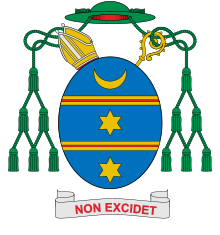
Arms of St Francis de Sales
Bishop of Geneva
In 1602, Bishop Granier died, and Sales was consecrated Bishop of Geneva, but resided in Annecy (now part of modern-day France) because Geneva remained under Calvinist control and therefore closed to him. His diocese became famous throughout Europe for its efficient organization, zealous clergy and well-instructed laity, monumental achievements in those days.[9]He worked closely with the Order of Friars Minor Capuchin, very active in preaching the Catholic faith in his diocese. They appreciated his cooperation so much that in 1617 they made him an official associate of the Order, the highest honor possible to a person outside it. It is said that at Evian, on the south shore of Lake Geneva, St. Francis of Assisi appeared to him and said: "You desire martyrdom, just as I once longed for it. But, like me, you will not obtain it. You will have to become an instrument of your own martyrdom."[7] During his years as bishop, Sales acquired a reputation as a spellbinding preacher and something of an ascetic. His motto was, "He who preaches with love, preaches effectively." His goodness, patience and mildness became proverbial.[8]
Mystical writer
These last qualities come through in Sales' books, the most famous of which was Introduction to the Devout Life, which – unusual for the time – was written specially for laypeople. In it he counseled charity over penance as a means of progressing in the spiritual life. Sales also left the mystical work, the "Treatise on the Love of God",[10] and many highly valued letters of spiritual direction, including those with Jane Frances de Chantal compiled in the Letters of Spiritual Direction.[11] He was a notably clear and graceful stylist in French, Italian and Latin.[citation needed]His writings on the perfections of the heart of Mary as the model of love for God influenced Jean Eudes to develop the devotion to the Hearts of Jesus and Mary.[12]
Founder
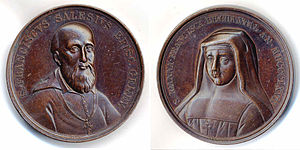
Francis de Sales and Jane Frances de Chantal, medal 1867
Sales also established a small community of men, an Oratory of St. Philip Neri, at Thonon-les-Bains, with himself as the superior or Provost. This work, however, was crippled by his death, and that foundation soon died out.[14]
Death
In December 1622 Sales was required to travel in the entourage of Charles Emmanuel I, Duke of Savoy, for the Duke's Christmas tour of his domain. Upon arrival in Lyon, he chose to stay in the gardener's hut at the Visitandine monastery in that city. While there he suffered a stroke, from which he died on 28 December 1622.[10]Veneration after his death
St. Francis de Sales has been styled "the Gentleman Saint" because of his patience and gentleness.[7] Despite the resistance of the populace of Lyon to moving his remains from that city, Sales was buried on 24 January 1623 in the church of the Monastery of the Visitation in Annecy, which he had founded with Chantal, who was also buried there. Their remains were venerated there until the French Revolution.[15] Many miracles have been reported at his shrine.Sales' heart was kept in Lyon, in response to the popular demand of the citizens of the city to retain his remains. During the French Revolution, however, it was taken to Venice, where it is venerated today.[citation needed]
Francis de Sales was beatified in 1661 by Pope Alexander VII, who then canonized him four years later. He was declared a Doctor of the Church by Pope Pius IX in 1877.[2]
The Roman Catholic Church celebrates St. Francis de Sales' feast on 24 January, the day of his burial in Annecy in 1624.[16] From the year 1666, when his feast day was inserted into the General Roman Calendar, until its 1969 revision, he was celebrated on 29 January, a date still observed by some Traditionalist Catholics.
St. Francis de Sales is recognized as an exemplary in the Church of England, where his memoria is also observed on 24 January, and in the Church in Wales, where his memorial was moved to 23 January, due to a conflict with that of St Cadoc.
Patronage
In 1923, Pope Pius XI proclaimed him a patron of writers and journalists, because he made extensive use of broadsheets and books both in spiritual direction and in his efforts to convert the Calvinists of the region.[5] St. Francis developed a sign language in order to teach a deaf man about God. Because of this, he is the patron saint of the deaf.[10]Having been founded as the first non-cloistered group of sisters after attempts to do so with the Visitation Sisters founded by de Sales and de Chantal proved unsuccessful, the Sisters of St. Joseph (founded in Le Puys, France, in 1650) take St. Francis de Sales as one of their patrons.
Legacy
Congregations
In the 19th century, his vision for religious communities was revived. Several religious institutes were founded during that period for men and women desiring to live out the spiritual path which de Sales had developed.- The Missionaries of St. Francis de Sales (M.S.F.S.), founded by the Abbé Pierre Mermier in 1838, were the first congregation to adopt his spirituality in the 19th century.
- The religious institute of the Salesians of Don Bosco (S.D.B.), founded by St. John Bosco in 1859 (approved by the Holy See in 1874), was originally named the Society of St. Francis de Sales, and was placed under his patronage.
- The Oblate Sisters of St. Francis de Sales (O.S.F.S.) were founded by St. Léonie Aviat and the Blessed Louis Brisson, under the spiritual guidance of the Venerable Marie de Sales Chappuis, V.H.M., in 1866.
- The Oblates of St. Francis de Sales (O.S.F.S.) were later founded by Brisson for men, also under the guidance of Mother Marie de Sales, in 1875.[9]
- The Paulist Fathers in the United States count him as one of their patrons.
Influence on other saints
Vincent de Paul met Francis de Sales in Paris in 1618 or 1619. Francis de Sales' spirituality and writings, especially An Introduction to the Devout Life, and Treatise on the Love of God, were to have a profound influence on Vincent.[8]Source: www.catholic.org
Subscribe to:
Posts (Atom)